
Trade Secret Theft in Texas: When to Sue — A Practical Guide for Houston Businesses
- The Spencer Law Firm
- Dec 13, 2025
- 6 min read
Sometimes you can feel a trade secret slipping out the door before you ever see the proof. A former employee downloads a strange folder at midnight. A competitor suddenly launches a product that looks exactly like yours. Or your biggest client list appears in someone else’s sales pitch almost word for word.
Here’s the truth: most Texas businesses wait too long to sue for trade secret theft, and by the time they act, the damage is already baked in.
This guide lays out the real, practical moment when a Houston-area business should take legal action—based on lived experience, courtroom realities, and the way Texas judges actually handle these cases.
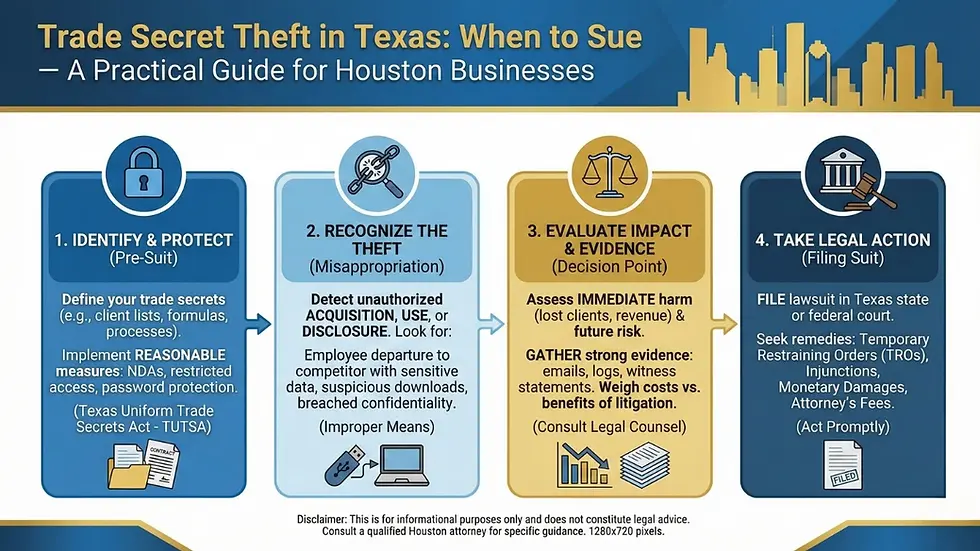
You should sue for trade secret theft in Texas when you have evidence or strong indicators of misappropriation, such as an ex-employee downloading confidential files, a competitor using your proprietary data, or unauthorized disclosure that threatens your business. Under TUTSA, you can seek a TRO, injunction, damages, and attorney’s fees to stop ongoing harm.
Quick Summary
If someone is using, threatening to use, or has taken your confidential business information → you may have a claim.
Texas law (TUTSA) protects data with actual commercial value that you’ve taken reasonable steps to protect.
Don’t wait—Texas courts favor fast action, especially for TROs.
Evidence disappears quickly. Digital forensics matters.
A Houston trade secret lawyer can help you act before the damage becomes permanent.
When a Suspicion Turns Into a Lawsuit Decision
There’s a moment every business owner remembers—when a gut feeling turns into something heavier. I still think about a Houston engineering firm that called me on a Tuesday morning after noticing an ex-project manager had logged into their SharePoint account after his last day. Nothing big at first glance… until they checked server logs.
He downloaded 420 proprietary design files. All within nine minutes.
Here’s where most businesses slip up: they talk themselves out of taking action.“He wouldn’t do that. “It’s probably nothing. “Let’s wait and see.”
But Texas trade secret litigation doesn’t reward hesitation. Under the Texas Uniform Trade Secrets Act (TUTSA), timing matters. Judges in Harris County pay close attention to how quickly a business moves once it discovers misappropriation. Delay can look like acceptance.
The real question becomes: At what point do you stop monitoring—and start suing?
Let’s break it down.
The Signs That It’s Time to Sue for Trade Secret Theft in Texas

The line between suspicion and a viable lawsuit is rarely clean. Still, patterns show up again and again across Houston businesses, tech startups, oil & gas outfits, medical practices, and even local construction groups. When these three conditions appear together, it’s usually time to file:
1. Evidence of Unauthorized Access or Downloading
This is the giveaway. Midnight logins. USB transfers. Unusual downloads days before resignation. I’ve watched companies panic when they realize the last 90 days of logs are already overwritten.
2. Competitive Use or Threat of Use
If a competitor suddenly mimics your pricing structure, approach, or product roadmap, and an ex-employee recently joined them, this is not a coincidence. Texas courts recognize “threatened misappropriation” as grounds for an injunction.
3. Actual Business Harm or Imminent Risk
If the theft puts your competitive edge at risk, client lists, formulas, code, and manufacturing processes, courts treat the matter seriously. TUTSA was built for this exact scenario.
A quick example: A SaaS company in The Woodlands called after noticing a competitor advertising a feature that hadn’t launched yet, except the only person who knew the algorithm had left the month before. That case turned into an emergency TRO within 48 hours.
What Counts as a Trade Secret Under Texas Law? (And What Doesn’t)

Here’s where things get messy, because not everything confidential is a trade secret.
Under TUTSA, a trade secret is information that:
has independent economic value
isn’t generally known
and you took reasonable steps to protect
That last part trips up half the businesses I talk to.
Let me give you an example. A Houston medical practice kept its proprietary patient outreach system on a shared drive named “Stuff.” No password. No NDA. No logging. When a former contractor copied the scripts and sold them to another clinic, the practice was furious. The case? Dead on arrival.
Because without reasonable precautions, the information isn’t legally a trade secret.
But when companies do secure their data, NDAs, access controls, training, and encryption, Texas courts enforce protection aggressively. Especially in tech, engineering, and oil & gas sectors.
The Moment You Must Act Fast: TROs & Injunctions

If you’re going to sue, the fastest—and most important—tool is a temporary restraining order (TRO). Houston judges often sign TROs the same day if the evidence is strong.
Why speed matters: Once trade secrets leak, they don’t come back. Courts know this. Texas case law knows this. Your competitors definitely know this.
A Houston manufacturing firm once discovered a former machinist emailing CAD files to a personal Gmail account. They called late on a Friday. By Monday morning, the competitor had already begun testing prototypes.
The TRO shut them down for two weeks. That breathing room alone saved the business.
You need to act when:
You see file transfers
You spot outgoing emails with attachments
A competitor starts using your confidential data
An employee departs under strange circumstances
A TRO freezes the situation. An injunction keeps it frozen.
Case Example: The Client List That Nearly Sank a Houston Firm
A professional services company in Harris County noticed long-time clients suddenly getting calls from a competitor, within days of an employee leaving. Clients even mentioned, “He seemed to know our renewal dates.”
The owner brushed it off. Bad move.
Three months later, revenue dropped 28%. They finally ran an audit and discovered the ex-employee had exported the CRM database the night before resigning.
We filed suit the next morning. The judge granted an injunction. Digital forensics recovered the evidence. But the lost clients? Those were gone forever.
Here’s the part nobody talks about: Trade secret cases rarely turn on what was stolen— but on how fast the business responded.
When to Hire a Texas Trade Secret Lawyer
The moment you see:
unexplained downloads
sudden competitive overlap
employee laptop wiping
unauthorized access
customer defection patterns
…you’re already behind.
A lawyer helps you:
preserve digital evidence
file an emergency TRO
notify the other party legally
conduct a forensic investigation
Identify the trade secret clearly
assess damages and injunction strategy
You’re not just fighting theft—you’re fighting the clock.
FAQs
How do I know if my information qualifies as a trade secret in Texas?
If it has commercial value, isn’t public, and you’ve taken steps to protect it (NDA, access limits, passwords), it likely qualifies.
Do I need proof before suing for trade secret theft?
You need evidence or strong indicators—server logs, access records, suspicious downloads absolute proof. Texas courts accept circumstantial evidence for TROs.
Can I sue an ex-employee for taking my client list?
Yes, if the list qualifies as a trade secret and they misappropriated it. Many client lists do meet TUTSA standards.
What damages can I recover in a Texas trade secret lawsuit?
Lost profits, unjust enrichment, punitive damages (for willful theft), and attorney’s fees in some cases.
Can I get an injunction to stop the ongoing misuse?
Absolutely. Injunctions are the backbone of trade secret protection in Texas.
Should small businesses bother pursuing these cases?
Yes. Trade secret theft can wipe out competitive advantage overnight. Small firms feel it fastest.
How long do I have to sue under TUTSA?
Generally, within 3 years of discovering the misappropriation, but waiting hurts your case.
What if the competitor is in another state?
TUTSA and the federal DTSA allow suit in Texas if the harm happened here.
If something feels off, trust that instinct. Trade secret theft rarely announces itself politely. It slips in quietly, usually through someone who knew exactly where your leverage lived.
Whether you’re a tech startup in Midtown, an oil & gas supplier off I-10, or a medical group serving west Houston, you can’t afford to wait.
If you’re seeing the warning signs, reach out. Your trade secrets are worth protecting—before someone else builds a business off your work.
Author
Written by a Team of Legal Content Writers at The Spencer Law firm, experts in Texas business litigation content, legal SEO strategy, and deeply human, authority-driven writing.
Disclaimer
This article provides general information about Texas trade secret law. It is not legal advice. If you believe your trade secrets have been misappropriated, consult a licensed Texas attorney.


Comments